Thought Leadership-Newsroom
Ask Alex: What is Cognitive Training Therapy
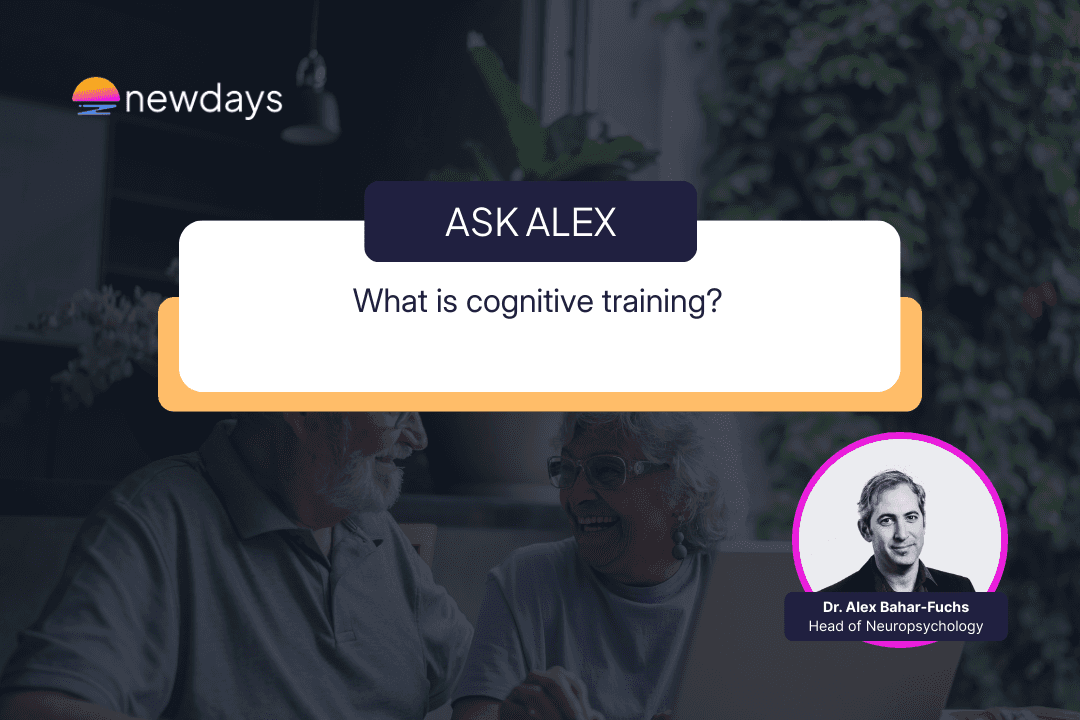
Dr. Alex Bahar-Fuchs is NewDays' Director of Neuropsychology and a leading expert in cognitive interventions for older adults.
Q: I see on your website that some of the conversations with the NewDays AI are considered "cognitive stimulation". What is that?
Dr. Alex:
What is cognitive training?
Cognitive training is a bit like the equivalent to structured physical training or exercise in the gym and is sometimes referred to by some as brain training.
The goal of cognitive training is to work on and improve a specific thinking skill or cognitive abilities such as memory, attention, speed, or executive function, to name just a few. This is usually achieved by repeatedly performing certain tasks that are designed specifically to target those skills.
These days such tasks tend to be completed on a computer and they are often gamifying to increase engagement, motivation, and pleasure.
Like the case for physical exercise, a key principle in cognitive training is to work at the level that provides just the right amount of mental challenge or effort. So ideally tasks should not be too easy, but also not too difficult. And in most cases, the level of difficulty will change as a result or as a function of our performance. So a task will become gradually more difficult when we do well, or it will become easier when we're struggling a little.
The key here is that we hope to see improvement not only in the ability or task that we're performing, but that that underlying skill or ability, for example, attention or memory will be strengthened so that when we engage in other tasks or activities that rely on that skill, our capacity to perform such tasks will also improve.
Using the example of attention span, we would expect that in addition to performing better on the task that we've been training on, we might also notice that everyday activities that require good attention span, for example, reading a book or listening to a set of instructions will also improve.
Although in most cases training focuses on repetition and practice, sometimes cognitive training involves learning specific strategies, practicing them, and then trying to apply them to novel situations. For instance, we might learn strategies to better organize or recall information or how to intentionally split our attention between two tasks we are trying to perform simultaneously. After applying the strategy to the performance of this specific task, we might try and use the strategy in another similar task.
Numerous cognitive training programs are available online, mostly requiring some form of subscription, and over recent years research has been conducted using some of these programs and generally provided preliminary support, suggesting that cognitive training is associated with improvement in specific cognitive abilities as well as more broadly in thinking cognition generally. These findings have been found for older people with and without cognitive impairment and have been supported by large meta-analytic studies which attempt to combine or synthesize the results of numerous other smaller studies.
Here at New Days, we have developed a cutting edge approach to deliver cognitive training using conversational AI tools, which is a novel and promising way of doing this, and you're invited to learn more about our approach on our website.
Have a question for Dr. Alex? Submit your cognitive health questions to hello@newdays.ai and it might be featured in our next Ask Alex post.
Next Article
Ready to get answers?
Schedule your free consultation with a NewDays clinician this week.
Available Monday-Friday via secure video call.